Dec. 27, 2006
The ferment forms eyes, which turn upon the ferment, in wonder.
I am rising into the atmosphere, looking down upon the earth. Time is accelerating, the earth spinning so fast I can no longer make out its surface. Higher and higher I go into outer space. Momentary flashing irregular pauses reveal successive cycles of decline and rebirth below: ice ages, droughts, floods.
Civilizations are rising and falling, overtaking one another, each building out toward the heavens before falling back to earth to be reclaimed by the soil and buried beneath the crude beginnings of its successor. These strobe-beats are coming so fast now that they resemble an old film. I try to reach back toward the earth, as if to capture it in my grasp; it is only then I realize I have no body.
The sun is dimming, turning red; the earth is cold, inert. All is a flash of blinding, platinum light, searing the eyes, as the dying sun explodes. The light recedes, leaving behind the earth, now a ball of flame trailing the phantom current of the blast. The rate of time's increase becomes unbearable; I feel it taking me apart, cell by cell, atom by atom. The earth is now a brilliant, orange-red ember glowing in an onyx sea dappled with pin-pricks of starlight. Already it is dimming, fading in concert with my own dissipation: body, sentience, memory, identity, all now indistinguishable as they pass into dust.
The ferment becomes aware, becomes self-aware, seeks to save itself through flight, succumbs and is submerged again in dissolution.
Our lives are futile escape attempts.
Showing posts with label stream of consciousness. Show all posts
Showing posts with label stream of consciousness. Show all posts
Saturday, September 05, 2015
Saturday Sermon
No Exit
(originally published on Dec 11, 2007)
Now that all the groups have disappeared, and every tribe has dispersed, we know ourselves as isolated but similar to each other, and we have lost the desire to unite.
—The Possibility of an Island, Michel Houellebecq
Reality is the only word in the English language that should always come in quotes.
—anonymous
Is that you, John Wayne? Is this me?
—“Cowboy,” The Short Timers, Gustav Hasford
Oh the things you’ll see! Oh the Places You'll Go!
—Dr. Seuss
We arrived at that place, finally. That imagined place where dreams were made real. Dreams of incomprehensible wonder revealing new, miraculous dimensions of imagination. The dreams held us in perpetual, childlike awe. But there we also found nightmares, nightmares we ourselves had released with the dreams. Nightmares at once unimaginable and familiar.
Once released the dreams and nightmares grew beyond our control. They merged and blended, endlessly recombining to create grotesque hybrids, spawning deformed children; all the while growing in number and mass. The sacred and the profane bled into one another until they became one. The sum of every dream became a communal dreamworld, the product of every mind and the product of no single mind.
Art was separated from artist. Meaning was being made meaningless. The people no longer controlled their imagination; it controlled them. The collective consciousness eroded and crowded out the individual. Privacy and solitude were becoming relics of the past. The people were becoming one unindividuated mass, like the inescapable dreamworld they beheld. Yet they were isolated from one another and alienated from the whole.
Every desire, every impulse, every fear and conceit, all vanity, was released to collect in an unintelligible mass overhead, lowering down upon them as it grew. All eyes turned upward, first in wonder and then in despair. Some warned that the dreamworld was displacing the real. But it was no use; there was no returning, and the authorless dreams and nightmares grew and combined as one, crowding out the sky, like a great, gathering storm.
Reality has competition. The virtual and the representational are gaining prominence in the individual and collective psyche, cutting into reality's market share. "Virtual" reality has even gained practical value. Everything that doesn't require direct human contact is gradually, inevitably, migrating away from it; economic utility alone ensures this. Engagement with one's fellows is increasingly unnecessary, and increasingly superfluous. It is now possible for one to survive within and even contribute to society without physically engaging it. For each one of us the necessity of human contact is diminishing. Human interaction is being rendered unnecessary
This fundamental shift is transpiring in a historical blink of the eye--within the span of a single lifetime. The experience of our youth is already antiquated; the world our children will pass on, unimaginable. We are on a path that seems predetermined to end with—or merely pass through—the manipulation of perception at the synaptic level, where experience lives. It is all but certain that we will eventually master the interface between perception and reality. We are not cutting out reality but cutting it off, stranding it. We are not "playing God", but displacing him. Reality is being made malleable, becoming a mere "social construct." But "reality" and "nature" are not the same thing. This we forget. Even as reality is coming apart at the seams, nature remains, utterly unchanged and unfazed, as indifferent as ever.
In the future it may come to pass that the individual will have less need for sociality. Evolutionary pressures for it may already be easing. Technology and human vanity combine to ensure that procreation itself will inevitably become a commercialized, streamlined, efficient process, with conception and gestation taking place in vitro and managed by professionals customizing their product for a clientele ordered by wealth; a hierarchy of reproduction intensifying human inequality and its attendant social stratification. Today's already disingenuous prohibition against eugenics doesn't stand a chance; it will eventually become a curiosity, if it is to be remembered at all. As for sex, romance and love; their connection to procreation is all but severed; they are now primarily recreational. Family as we know it will pass into history, but the struggle for genetic predominance will continue. It may become a rout as some enjoy unlimited access, and others are shut out entirely.
There is no guarantee that in the future the individual will not select, and be selected for, solitariness. As it is, a growing percentage of the populace is disengaged from and irrelevant to the politics and governance of society. As the average person's personal liberty grows in the absence of any authority over it, such as by church or community, indeed, as personal liberty becomes the highest virtue, his political autonomy and influence lessens, and he is increasingly irrelevant to a polity he finds confusing, opaque, and unresponsive.
The common man concedes influence in exchange for being left alone; he can count not being pressed into the service of defending the nation or contributing to its welfare or governance beyond paying taxes. He enjoys unprecedented personal liberty and unprecedented social irrelevance. He is left to his amusements; lurid, hyper-lucid and hyper-stimulating ("more real than real")—sensually and morally deadening. Over the horizon somewhere another class, increasingly alien, works the levers of society and gathers privilege unto itself.
Culture today still retains its partly shamanistic roots—imposing the necessary illusion of order on a natural world fundamentally incomprehensible due to its sheer size and totality; that the human heart can be cordoned off from nature is an ancient dream we still pursue. This fundamental religious belief is what made civilization possible. Absolute truth had to be declared and established before it could be determined (and before we could set out on the path to where we now enjoy the conceit of declaring it nonexisent). Society had to drop anchor somewhere, anywhere, to establish an immutable reference point, to free itself from its primordial drift. But still it is an illusion, and as such it could not last. The illusion has been exposed; we are cut adrift once more.
For the ancients it was the indecipherable chaos of the capricious elements upon which a semblance of order had to be overlaid; a mythology of cause and effect had to be created, and eventually the gods were born. Scientific revelation, in laying bare the patterns underlying the confusion and demystifying the sacred mysteries of sky and stars, incidentally exposed and killed the gods. But nature's indifference and caprice still haunt us. New mythologies are hastily erected in the form of sociological conceits: ideology, philosophy, social theory and criticism. But they are ad hoc, cobbled together; they fall as rapidly as we put them up. Mystery is no longer the overriding feature of the physical world. Now it is the confusion of a species whose awareness has outstripped its evolutionary pace—that has outrun nature but cannot overcome it. We are still uncovering patterns, still killing gods.
Nature means, literally, everything. Out of necessity we create false layers of remove between ourselves and nature; arbitrary, imaginary divides. But, as with all human artifice, their erosion begins before they are even finished, before they come into being. Nature works upon us even through the very barriers we erect. The clock is always ticking. Human convention is no less a product of nature than anything else, and in nature there is no such thing as permanence. Nature has time we don't. Literally, all the time in the world. Nature is time. Flux is its only permanent feature.
Meanwhile, we have grown bored with merely manipulating our physical environment. The pace of change has made a mockery of permanence, so we mock and deride the social conventions attempting to preserve a semblance of it, otherwise known as community, habitually. This exposes a lack of confidence. Of faith. Paranoia is imprinted in our genetic code; we sense there's something else out there. We attempt to give shape and form to this vague fear.
What should be the ultimate practical concern, the physical environment, takes on a religious, millenarian air; mainstream environmentalism prophesies catastrophic wrath to be visited upon us for our sins if we do not admonish ourselves and atone. Alarmed at our very real and apparently boundless hubris, we fashion myths of a vengeful nature wreaking havoc on us and reclaiming the land.
Global warming and AIDS have both become political and social movements predicated on a mythology of hubris and social injustice bringing about catastrophe. But beneath this lurks nothing so much as a profound lack of confidence, not entirely misplaced perhaps, in the ultimate wisdom of human society. Beyond hardcore political activism, the unacknowledged subtext of AIDS as a social phenomenon is the hope, now revealed as hopeless, that the disease would, finally, chasten humanity to temper its headlong descent into sexual immorality and chaos. Remember when "AIDS changed everything"?
Likewise global warming is being invested with the hope that it will spur a revolution in the production of energy, just in time to head off the next global conflict and make a Third World as rich in resources as it is in hostility irrelevant.
In the end, catastrophe mythology is not, as it appears at first glance, misanthropic conceit, but collective vainglory. We give ourselves too much credit. Nature will indeed reclaim the dominion it never really relinquished, but it will have nothing to do with us. We are not even bit players in nature's tragicomedy, but mere scenery. It is we that we need to keep our eyes on.
Violence permeates the culture, but the reality of daily life for the vast majority is excruciatingly dull in comparison to the alternate reality of cinema and video games. For sensational appeal, it simply cannot compete. The innate aggression and paranoia of the average man is increasingly aroused in inverse proportion to its decreasing necessity.
We have not conquered but insulated ourselves from the physical world, and have begun the logical next step, crafting an alternate reality—a reality manipulable at the individual level. Meanwhile nature still inhabits this false idyll, untold patterns unfolding still. We delude ourselves that nature has been marginalized, finally made small and comprehensible, but we can no more escape her than we can escape ourselves.
In a culture with no center, taken over entirely by commerce, prominence of place is awarded entirely by mass appeal. The vulgar shares space with the formerly sacrosanct. The common cannot be ennobled by its elevation, but its opposite cannot avoid being trivialized by being made common.
Decency cannot survive an order determined by sensationalism. Real life horrors compete for attention with their fictional counterparts. The collective imagination conflates and confuses them. In the end, it all must combine; beauty and ugliness, truth and fiction. In the historical memory they will be indistinguishable. In our minds they nearly are already.
So, what then? I propose no action, no change of course, no return, because these are impossible. There is no going back. It is only for us to gaze in wonder and hold on tight.
(originally published on Dec 11, 2007)
Now that all the groups have disappeared, and every tribe has dispersed, we know ourselves as isolated but similar to each other, and we have lost the desire to unite.
—The Possibility of an Island, Michel Houellebecq
Reality is the only word in the English language that should always come in quotes.
—anonymous
Is that you, John Wayne? Is this me?
—“Cowboy,” The Short Timers, Gustav Hasford
Oh the things you’ll see! Oh the Places You'll Go!
—Dr. Seuss
We arrived at that place, finally. That imagined place where dreams were made real. Dreams of incomprehensible wonder revealing new, miraculous dimensions of imagination. The dreams held us in perpetual, childlike awe. But there we also found nightmares, nightmares we ourselves had released with the dreams. Nightmares at once unimaginable and familiar.
Once released the dreams and nightmares grew beyond our control. They merged and blended, endlessly recombining to create grotesque hybrids, spawning deformed children; all the while growing in number and mass. The sacred and the profane bled into one another until they became one. The sum of every dream became a communal dreamworld, the product of every mind and the product of no single mind.
Art was separated from artist. Meaning was being made meaningless. The people no longer controlled their imagination; it controlled them. The collective consciousness eroded and crowded out the individual. Privacy and solitude were becoming relics of the past. The people were becoming one unindividuated mass, like the inescapable dreamworld they beheld. Yet they were isolated from one another and alienated from the whole.
Every desire, every impulse, every fear and conceit, all vanity, was released to collect in an unintelligible mass overhead, lowering down upon them as it grew. All eyes turned upward, first in wonder and then in despair. Some warned that the dreamworld was displacing the real. But it was no use; there was no returning, and the authorless dreams and nightmares grew and combined as one, crowding out the sky, like a great, gathering storm.
Reality has competition. The virtual and the representational are gaining prominence in the individual and collective psyche, cutting into reality's market share. "Virtual" reality has even gained practical value. Everything that doesn't require direct human contact is gradually, inevitably, migrating away from it; economic utility alone ensures this. Engagement with one's fellows is increasingly unnecessary, and increasingly superfluous. It is now possible for one to survive within and even contribute to society without physically engaging it. For each one of us the necessity of human contact is diminishing. Human interaction is being rendered unnecessary
This fundamental shift is transpiring in a historical blink of the eye--within the span of a single lifetime. The experience of our youth is already antiquated; the world our children will pass on, unimaginable. We are on a path that seems predetermined to end with—or merely pass through—the manipulation of perception at the synaptic level, where experience lives. It is all but certain that we will eventually master the interface between perception and reality. We are not cutting out reality but cutting it off, stranding it. We are not "playing God", but displacing him. Reality is being made malleable, becoming a mere "social construct." But "reality" and "nature" are not the same thing. This we forget. Even as reality is coming apart at the seams, nature remains, utterly unchanged and unfazed, as indifferent as ever.
In the future it may come to pass that the individual will have less need for sociality. Evolutionary pressures for it may already be easing. Technology and human vanity combine to ensure that procreation itself will inevitably become a commercialized, streamlined, efficient process, with conception and gestation taking place in vitro and managed by professionals customizing their product for a clientele ordered by wealth; a hierarchy of reproduction intensifying human inequality and its attendant social stratification. Today's already disingenuous prohibition against eugenics doesn't stand a chance; it will eventually become a curiosity, if it is to be remembered at all. As for sex, romance and love; their connection to procreation is all but severed; they are now primarily recreational. Family as we know it will pass into history, but the struggle for genetic predominance will continue. It may become a rout as some enjoy unlimited access, and others are shut out entirely.
There is no guarantee that in the future the individual will not select, and be selected for, solitariness. As it is, a growing percentage of the populace is disengaged from and irrelevant to the politics and governance of society. As the average person's personal liberty grows in the absence of any authority over it, such as by church or community, indeed, as personal liberty becomes the highest virtue, his political autonomy and influence lessens, and he is increasingly irrelevant to a polity he finds confusing, opaque, and unresponsive.
The common man concedes influence in exchange for being left alone; he can count not being pressed into the service of defending the nation or contributing to its welfare or governance beyond paying taxes. He enjoys unprecedented personal liberty and unprecedented social irrelevance. He is left to his amusements; lurid, hyper-lucid and hyper-stimulating ("more real than real")—sensually and morally deadening. Over the horizon somewhere another class, increasingly alien, works the levers of society and gathers privilege unto itself.
Culture today still retains its partly shamanistic roots—imposing the necessary illusion of order on a natural world fundamentally incomprehensible due to its sheer size and totality; that the human heart can be cordoned off from nature is an ancient dream we still pursue. This fundamental religious belief is what made civilization possible. Absolute truth had to be declared and established before it could be determined (and before we could set out on the path to where we now enjoy the conceit of declaring it nonexisent). Society had to drop anchor somewhere, anywhere, to establish an immutable reference point, to free itself from its primordial drift. But still it is an illusion, and as such it could not last. The illusion has been exposed; we are cut adrift once more.
For the ancients it was the indecipherable chaos of the capricious elements upon which a semblance of order had to be overlaid; a mythology of cause and effect had to be created, and eventually the gods were born. Scientific revelation, in laying bare the patterns underlying the confusion and demystifying the sacred mysteries of sky and stars, incidentally exposed and killed the gods. But nature's indifference and caprice still haunt us. New mythologies are hastily erected in the form of sociological conceits: ideology, philosophy, social theory and criticism. But they are ad hoc, cobbled together; they fall as rapidly as we put them up. Mystery is no longer the overriding feature of the physical world. Now it is the confusion of a species whose awareness has outstripped its evolutionary pace—that has outrun nature but cannot overcome it. We are still uncovering patterns, still killing gods.
Nature means, literally, everything. Out of necessity we create false layers of remove between ourselves and nature; arbitrary, imaginary divides. But, as with all human artifice, their erosion begins before they are even finished, before they come into being. Nature works upon us even through the very barriers we erect. The clock is always ticking. Human convention is no less a product of nature than anything else, and in nature there is no such thing as permanence. Nature has time we don't. Literally, all the time in the world. Nature is time. Flux is its only permanent feature.
Meanwhile, we have grown bored with merely manipulating our physical environment. The pace of change has made a mockery of permanence, so we mock and deride the social conventions attempting to preserve a semblance of it, otherwise known as community, habitually. This exposes a lack of confidence. Of faith. Paranoia is imprinted in our genetic code; we sense there's something else out there. We attempt to give shape and form to this vague fear.
What should be the ultimate practical concern, the physical environment, takes on a religious, millenarian air; mainstream environmentalism prophesies catastrophic wrath to be visited upon us for our sins if we do not admonish ourselves and atone. Alarmed at our very real and apparently boundless hubris, we fashion myths of a vengeful nature wreaking havoc on us and reclaiming the land.
Global warming and AIDS have both become political and social movements predicated on a mythology of hubris and social injustice bringing about catastrophe. But beneath this lurks nothing so much as a profound lack of confidence, not entirely misplaced perhaps, in the ultimate wisdom of human society. Beyond hardcore political activism, the unacknowledged subtext of AIDS as a social phenomenon is the hope, now revealed as hopeless, that the disease would, finally, chasten humanity to temper its headlong descent into sexual immorality and chaos. Remember when "AIDS changed everything"?
Likewise global warming is being invested with the hope that it will spur a revolution in the production of energy, just in time to head off the next global conflict and make a Third World as rich in resources as it is in hostility irrelevant.
In the end, catastrophe mythology is not, as it appears at first glance, misanthropic conceit, but collective vainglory. We give ourselves too much credit. Nature will indeed reclaim the dominion it never really relinquished, but it will have nothing to do with us. We are not even bit players in nature's tragicomedy, but mere scenery. It is we that we need to keep our eyes on.
Violence permeates the culture, but the reality of daily life for the vast majority is excruciatingly dull in comparison to the alternate reality of cinema and video games. For sensational appeal, it simply cannot compete. The innate aggression and paranoia of the average man is increasingly aroused in inverse proportion to its decreasing necessity.
We have not conquered but insulated ourselves from the physical world, and have begun the logical next step, crafting an alternate reality—a reality manipulable at the individual level. Meanwhile nature still inhabits this false idyll, untold patterns unfolding still. We delude ourselves that nature has been marginalized, finally made small and comprehensible, but we can no more escape her than we can escape ourselves.
In a culture with no center, taken over entirely by commerce, prominence of place is awarded entirely by mass appeal. The vulgar shares space with the formerly sacrosanct. The common cannot be ennobled by its elevation, but its opposite cannot avoid being trivialized by being made common.
Decency cannot survive an order determined by sensationalism. Real life horrors compete for attention with their fictional counterparts. The collective imagination conflates and confuses them. In the end, it all must combine; beauty and ugliness, truth and fiction. In the historical memory they will be indistinguishable. In our minds they nearly are already.
So, what then? I propose no action, no change of course, no return, because these are impossible. There is no going back. It is only for us to gaze in wonder and hold on tight.
Friday, May 03, 2013
The Carrot and the Stick
All of these fatigued and serious faces showed no evidence of despair...they made their way with the resigned expression of those who are condemned to hope forever.
--Charles Baudelaire, To Each His Own Chimera
Human beings are, necessarily, actors who...can be divided...into the sane who know they are acting and the mad who do not.
--W.H. Auden
What made my dreams so hollow?
--Tom Waits, The Train Song
You will not be cured. Live long enough and the realization can no longer be deferred. The expectation you've sustained--that has in return sustained you--that over time, with work and luck, you will make yourself whole, is a fraud. A necessary fraud, but a fraud nonetheless. It is not possible. You cannot "find" yourself, as the widely ridiculed cliché would have it--we ridicule it only because it's naïve to speak of it, not because we aren't each guilty of the conceit--because your self is not out there to be found. A thing can't be both seeker and sought. The eye cannot turn upon itself. And the conscious self reduces down entirely to point of view.
But we can't help trying. Each of us, to the extent we're not simply waiting out mortality eating, shitting, acquiring, procreating--to the extent we're human--is a philosopher. We want to know, and the only real object of inquiry left is the conscious self. It's the last mystery. Everything else is biology, physics, evolution. Technical issues.
The only thing setting us apart from the apes--those living, breathing mockeries of the noble idea of man-in-God's-image--is our ability and need to form this question. So, if the self is one's unique identity, and everything else is animal function, then the searching for the self, absurd and impossible, is the only self there is. The physical world, while infinitely vast, is infinitely explainable. Scientific questions will always arise, but so will their answers. We can assume every one of them has a solution, whether we've found it yet or not. There is only one question that has no answer: Why? In the first place, why?
Man has gone in search of God and he has found the void. The void will not hear our appeals, will neither love nor judge us, will not put things to rights; it is indifference itself. This pathetic lament is the last argument in favor of the existence of God; but I will not be led by an appeal to consequences--no matter how unthinkable the consequences. I will have the consequences, thank you; you can have the appeal. Take your fairy tale, if it sustains you. But take it somewhere else. I retain my sympathy, even some respect, for the religious. But I'm all out of patience for them.
Should I speak only for myself? Okay then. I will not be made whole; I will die as I was born: unfinished, incomplete, ill-adapted and ignorant. I'm okay with this; whatever the case, there's nothing else for it, and I'm in no hurry to prove this thesis. And anyway, I could be wrong. Now don't run off; humor me a bit longer. You've got nowhere to go, and besides, none of this is what I came to say. My concerns are of the petty, selfish variety--the only honest kind, in other words.
I've always been afraid of two things: beginnings and endings. I'm afraid to "take the leap" into new endeavor; I will stay for years in the same physical or metaphorical place purely out of inertia--often in tormented awareness of the fact. But I fear more finishes and finality--at least some part manifestation of my fear of death. I once took a job selling--or trying to sell--cars. I was thoroughly incapable. I couldn't "close". Second only to closing in my dread was opening the sale. Introducing myself. This holds mostly constant for me. The only thing I can bear, the only thing that feels natural to me, is the stringing along of a thing.
I want to fiddle in the middle. Better still to go back periodically, not to the beginning, but to some earlier point. Even as a young boy I recall wanting to go back in time, to correct mistakes, to retrieve something irretrievable--never anything specific. I've just always been haunted by the vague suspicion I've screwed up. I don't defend this. I know it's untenable; I have paid dearly for it. Still, I despise you for not understanding. I despise your practicality. I despise your literal-mindedness, your impatience with all this, your perfectly logical and correct arguments. To hell with your careers, to hell with your ambition, to hell with your concern! To hell with you, closers, and this world of yours!
I say this because there was another, undeniable aspect to my aversion to closing the deal. Something less flattering still. I don't understand the appeal of bending someone to my will, of seduction--even of women. It repulses me, almost as much as the idea of being seduced. I always feel guilty about it. It is degrading. Maybe it's really just pride, pathological egoism--I refuse to play along, to compromise. I will not bow, I will not appeal, and I will not act the part. I have a few problems, you see, with my character as written in the script. I want to know who wrote these lines anyway. I will not read them--they are all trite cliché. I'm not feeling it. What about the audience? To hell with them. I didn't charge admission. I can't see beyond the floodlights; I'm not sure they're out there.
Yes, I know--the closing must be done; the cars have to be sold. The seductions, and subsequent screwing, must take place. Somebody has to do it. If no one does it, it won't get done, and if it doesn't get done, we'll suffer for it. But must everyone have join in, for Christ's sake? Modern life increasingly demands we all be closers--or closed upon. Closers run the world. What about creativity, you say? There are creators--like those who invented the car. But notice: they don't run things. They have some influence, often very much influence, yes, but they don't have the last word in this world. It's right there in the contract: they get a percentage of the gross, but they don't have final cut. Who does? Politicians? Well, that's what they call themselves, but what they really are is salesmen. Closers. And what they sell is necessarily corrupted. It's used by various interests. The world is run by used car salesmen. They even look the part, only somewhat better dressed. Their patter is, if anything, less honest. But this isn't what I came to say either.
I have given up the ghost--now don't start, it's not as grim as that. And some day--it's inevitable--you will too, if only on your deathbed. You fear this like the onset of dementia in old age, or like falling under the sway of a cult. You see it as death itself. Me, I can't remember truly caring. I have only wanted to escape it. Now I can't fake it anymore--yet I have to go on living. The battle has been lost but there is no surrender, no merciful slaughter; no resolution. I must go on fighting--I'm not the type to put a gun to my head. I am too jealous, too greedy, too envious for that, after all my gloating disdain for concern. I'm not leaving this all to you bastards. I might miss something! So I am condemned, not to die but to live.
But I have sinned; that's the worst of it. Because I have not contributed. It was pride that would not let me step onto the wire. I would not risk it. I have been a free-rider the whole time, the worst kind, the kind who consoles himself with the notion he's been cheated. But I haven't gotten away with it; mediocrity is its own punishment. I committed the worst sin of the healthy and sane: I held back. I was a miser, hoarding himself. Recently I read about a "hoarder" who'd been found, dead for weeks, buried in the refuse he wouldn't part with. That's how they'll find me, amidst the half-baked ideas, the false starts, the if-only regrets that are my refuse. For what was I saving myself? What did I expect to happen? I made an assumption that isn't mine to make--that none of it matters. Now that assumption fails too. What's the first thing to give with age? Certainty.
Those who act are better, nobler; they operate on faith, on the faith there is meaning, despite all evidence to the contrary. It takes faith to buy in without guarantee. And faith is all we ever had to go on in the end, in the absence of signs.
Ironic isn't it? But faith is all we have left in the absence of God.
All of these fatigued and serious faces showed no evidence of despair...they made their way with the resigned expression of those who are condemned to hope forever.
--Charles Baudelaire, To Each His Own Chimera
Human beings are, necessarily, actors who...can be divided...into the sane who know they are acting and the mad who do not.
--W.H. Auden
What made my dreams so hollow?
--Tom Waits, The Train Song
You will not be cured. Live long enough and the realization can no longer be deferred. The expectation you've sustained--that has in return sustained you--that over time, with work and luck, you will make yourself whole, is a fraud. A necessary fraud, but a fraud nonetheless. It is not possible. You cannot "find" yourself, as the widely ridiculed cliché would have it--we ridicule it only because it's naïve to speak of it, not because we aren't each guilty of the conceit--because your self is not out there to be found. A thing can't be both seeker and sought. The eye cannot turn upon itself. And the conscious self reduces down entirely to point of view.
But we can't help trying. Each of us, to the extent we're not simply waiting out mortality eating, shitting, acquiring, procreating--to the extent we're human--is a philosopher. We want to know, and the only real object of inquiry left is the conscious self. It's the last mystery. Everything else is biology, physics, evolution. Technical issues.
The only thing setting us apart from the apes--those living, breathing mockeries of the noble idea of man-in-God's-image--is our ability and need to form this question. So, if the self is one's unique identity, and everything else is animal function, then the searching for the self, absurd and impossible, is the only self there is. The physical world, while infinitely vast, is infinitely explainable. Scientific questions will always arise, but so will their answers. We can assume every one of them has a solution, whether we've found it yet or not. There is only one question that has no answer: Why? In the first place, why?
Man has gone in search of God and he has found the void. The void will not hear our appeals, will neither love nor judge us, will not put things to rights; it is indifference itself. This pathetic lament is the last argument in favor of the existence of God; but I will not be led by an appeal to consequences--no matter how unthinkable the consequences. I will have the consequences, thank you; you can have the appeal. Take your fairy tale, if it sustains you. But take it somewhere else. I retain my sympathy, even some respect, for the religious. But I'm all out of patience for them.
Should I speak only for myself? Okay then. I will not be made whole; I will die as I was born: unfinished, incomplete, ill-adapted and ignorant. I'm okay with this; whatever the case, there's nothing else for it, and I'm in no hurry to prove this thesis. And anyway, I could be wrong. Now don't run off; humor me a bit longer. You've got nowhere to go, and besides, none of this is what I came to say. My concerns are of the petty, selfish variety--the only honest kind, in other words.
I've always been afraid of two things: beginnings and endings. I'm afraid to "take the leap" into new endeavor; I will stay for years in the same physical or metaphorical place purely out of inertia--often in tormented awareness of the fact. But I fear more finishes and finality--at least some part manifestation of my fear of death. I once took a job selling--or trying to sell--cars. I was thoroughly incapable. I couldn't "close". Second only to closing in my dread was opening the sale. Introducing myself. This holds mostly constant for me. The only thing I can bear, the only thing that feels natural to me, is the stringing along of a thing.
I want to fiddle in the middle. Better still to go back periodically, not to the beginning, but to some earlier point. Even as a young boy I recall wanting to go back in time, to correct mistakes, to retrieve something irretrievable--never anything specific. I've just always been haunted by the vague suspicion I've screwed up. I don't defend this. I know it's untenable; I have paid dearly for it. Still, I despise you for not understanding. I despise your practicality. I despise your literal-mindedness, your impatience with all this, your perfectly logical and correct arguments. To hell with your careers, to hell with your ambition, to hell with your concern! To hell with you, closers, and this world of yours!
I say this because there was another, undeniable aspect to my aversion to closing the deal. Something less flattering still. I don't understand the appeal of bending someone to my will, of seduction--even of women. It repulses me, almost as much as the idea of being seduced. I always feel guilty about it. It is degrading. Maybe it's really just pride, pathological egoism--I refuse to play along, to compromise. I will not bow, I will not appeal, and I will not act the part. I have a few problems, you see, with my character as written in the script. I want to know who wrote these lines anyway. I will not read them--they are all trite cliché. I'm not feeling it. What about the audience? To hell with them. I didn't charge admission. I can't see beyond the floodlights; I'm not sure they're out there.
Yes, I know--the closing must be done; the cars have to be sold. The seductions, and subsequent screwing, must take place. Somebody has to do it. If no one does it, it won't get done, and if it doesn't get done, we'll suffer for it. But must everyone have join in, for Christ's sake? Modern life increasingly demands we all be closers--or closed upon. Closers run the world. What about creativity, you say? There are creators--like those who invented the car. But notice: they don't run things. They have some influence, often very much influence, yes, but they don't have the last word in this world. It's right there in the contract: they get a percentage of the gross, but they don't have final cut. Who does? Politicians? Well, that's what they call themselves, but what they really are is salesmen. Closers. And what they sell is necessarily corrupted. It's used by various interests. The world is run by used car salesmen. They even look the part, only somewhat better dressed. Their patter is, if anything, less honest. But this isn't what I came to say either.
I have given up the ghost--now don't start, it's not as grim as that. And some day--it's inevitable--you will too, if only on your deathbed. You fear this like the onset of dementia in old age, or like falling under the sway of a cult. You see it as death itself. Me, I can't remember truly caring. I have only wanted to escape it. Now I can't fake it anymore--yet I have to go on living. The battle has been lost but there is no surrender, no merciful slaughter; no resolution. I must go on fighting--I'm not the type to put a gun to my head. I am too jealous, too greedy, too envious for that, after all my gloating disdain for concern. I'm not leaving this all to you bastards. I might miss something! So I am condemned, not to die but to live.
But I have sinned; that's the worst of it. Because I have not contributed. It was pride that would not let me step onto the wire. I would not risk it. I have been a free-rider the whole time, the worst kind, the kind who consoles himself with the notion he's been cheated. But I haven't gotten away with it; mediocrity is its own punishment. I committed the worst sin of the healthy and sane: I held back. I was a miser, hoarding himself. Recently I read about a "hoarder" who'd been found, dead for weeks, buried in the refuse he wouldn't part with. That's how they'll find me, amidst the half-baked ideas, the false starts, the if-only regrets that are my refuse. For what was I saving myself? What did I expect to happen? I made an assumption that isn't mine to make--that none of it matters. Now that assumption fails too. What's the first thing to give with age? Certainty.
Those who act are better, nobler; they operate on faith, on the faith there is meaning, despite all evidence to the contrary. It takes faith to buy in without guarantee. And faith is all we ever had to go on in the end, in the absence of signs.
Ironic isn't it? But faith is all we have left in the absence of God.
Thursday, June 17, 2010
Cadence Song
Me? I hope to go out singing, defiantly. Like DeNiro's redneck Nemesis in Cape Fear, warbling in tongues as the rising tide consumes him. I want to play myself over this way, a segue between shows, until the dirty water fills my lungs. It's not bravery, it's denial; and denial gets a bad rap. Denial is essential. Here's to denial! Without it life would not be possible.
I had a moment of clarity--terror, that is--recently, regarding the reality of death. You may know what I'm talking about. These moments when the veil lifts, for no apparent reason. You stumble into the misty vale; you are suddenly lost. The unwelcome result of too much time alone. Solitude is dangerous. Solitude is a faint whiff of death. Solitude is death's annex. I didn't choose solitude, it chose me.
I think about death all the time, but from a cowardly psychological remove; indeed, the thinking and talking about death are just skirting about the reality, as if to appease it, or perhaps find some soft point of entry. We turn a thing over in our mind endlessly, compulsively, as if to discover it anew; we think our gaze has transforming powers. How can a thing be seen, named, obsessed over, so familiar, so present and still taunt us with its opacity and mystery?
Death is an impermeable thing because oblivion, or non-existence, is necessarily beyond comprehension. The mind cannot step outside itself in the end. You can't imagine, much less know, it; we make do with the possibility of a thing called oblivion; an alternative to the fire of redemption, before which we alternately cower or warm ourselves. But then, perhaps non-existence simply isn't possible. If energy never really dissipates, but merely transfers, morphing endlessly in an ultimately meaningless burlesque, why then should we cease to exist? Vapor, too, is a state of existence. Immortality is no less plausible than mortality. But the question cannot be answered. Each will learn--or not--for himself, alone, and only upon passing. Curious? You first.
This is why religion is a necessary constant of human behavior. Death is why the organized atheists can only piss into the wind endlessly. Theirs is a sterile zeal. Death is the darkened face of nature's mocking mystery; death will forever be the abyss, the reason why the Known will always be but a sheen over the far greater Unknown.
Buck up, friend! Come along with me! We'll sing together the tune we know by heart. We'll sing like the hopeless do, like the doomed and the damned will, when there's nothing left but the breath in their lungs. We'll shed our heartaches along the way. Think not of death but life. Death will abandon discretion to reveal himself soon enough. He's already here with us.
I had a moment of clarity--terror, that is--recently, regarding the reality of death. You may know what I'm talking about. These moments when the veil lifts, for no apparent reason. You stumble into the misty vale; you are suddenly lost. The unwelcome result of too much time alone. Solitude is dangerous. Solitude is a faint whiff of death. Solitude is death's annex. I didn't choose solitude, it chose me.
I think about death all the time, but from a cowardly psychological remove; indeed, the thinking and talking about death are just skirting about the reality, as if to appease it, or perhaps find some soft point of entry. We turn a thing over in our mind endlessly, compulsively, as if to discover it anew; we think our gaze has transforming powers. How can a thing be seen, named, obsessed over, so familiar, so present and still taunt us with its opacity and mystery?
Death is an impermeable thing because oblivion, or non-existence, is necessarily beyond comprehension. The mind cannot step outside itself in the end. You can't imagine, much less know, it; we make do with the possibility of a thing called oblivion; an alternative to the fire of redemption, before which we alternately cower or warm ourselves. But then, perhaps non-existence simply isn't possible. If energy never really dissipates, but merely transfers, morphing endlessly in an ultimately meaningless burlesque, why then should we cease to exist? Vapor, too, is a state of existence. Immortality is no less plausible than mortality. But the question cannot be answered. Each will learn--or not--for himself, alone, and only upon passing. Curious? You first.
This is why religion is a necessary constant of human behavior. Death is why the organized atheists can only piss into the wind endlessly. Theirs is a sterile zeal. Death is the darkened face of nature's mocking mystery; death will forever be the abyss, the reason why the Known will always be but a sheen over the far greater Unknown.
Buck up, friend! Come along with me! We'll sing together the tune we know by heart. We'll sing like the hopeless do, like the doomed and the damned will, when there's nothing left but the breath in their lungs. We'll shed our heartaches along the way. Think not of death but life. Death will abandon discretion to reveal himself soon enough. He's already here with us.
Sunday, December 13, 2009
Possession
I confess I've never been overtaken entirely by passion. I've never given myself over unconditionally and without reservation to anything; neither joy nor grief, hate nor love. Likewise for any given idea; but this is just another way of saying the same thing, for the passions are ideas too. The purest ideas, confounding transposition into mere language and only hinted at by even the most sublime art. One has to live such ideas. The poets tell us the lover, as opposed to the merely amorous, is a zealot prepared to accept death itself on behalf of the idea of love.
But for me always there is an inaccessible self-consciousness, a clinical awareness that becomes alien. There is a foreigner within narrating the varying circumstances of my existence: so this is Dennis stricken with grief; so this is Dennis afflicted by love; etc. It has taken in every tragedy or conquest, every humiliation and all the pride, unaffected. This awareness constitutes, impossible I know, a distinct entity. Another Dennis.
I've always had my suspicions about this separate consciousness that is not conscience. It's not the opposite of the conscience, but the absence of it, that part between mindless instinct and moral self-awareness. It--he--observes me as if from without. He waits for the thing, whatever it is, to end; he makes no distinctions of geography--the peak of Everest or the easy chair, it's no difference. He takes everything in with a wonder-less curiosity, and never with surprise, even as he takes note of the novelty of a given occurrence, how familiar it is, or not, how it might change the dynamic of my existence, but not really, because, he knows, it's all just protocol and convention in the end, until it all ends--and this I expect he will witness with the same idle, abstract gaze. He is impossibly inhuman.
But there he is, always, looking down on the confusion of my psyche as if through impenetrable glass. I can only dimly sense his formless presence behind the reflection I cast on the pane separating us--of me, unsentimental and unforgiving in its clarity. He sees all and records nothing; he doesn't care. He humors no vanity. He has the goods on me; he doesn't care. He taunts me with his lack of reproach for anything, great or small. He will not be run off; he can't be gotten to. His indifference is eternal, mocking, superior.
I've felt passion, of course, even "deeply", whatever that means to you. But if a man hasn't at least once been "consumed" or "blinded" by passion, whether it be love or hate (and what's the difference, in the end, between these inversions of each other?), he cannot say he knows them. It then follows that he cannot recognize them in others; he can only behave as if he understands. He knows what a thing is supposed to look like and responds accordingly, in the interests of order, but mostly out of habit. Eastern mystics of one sort or another--and I can't tell them apart--might say he is unrealized as a human being.
But a human can only be human, in part and in whole, no more or less in the depths of "inhumanity", and always. The depraved man appalls us not only for his deeds but for his irrefutable demonstration of humanity's potential for evil; it must then follow that he demonstrates for each of us our own capacity for evil, because we cannot escape the bond that is our shared humanity. With each transgression the evil expand the Devil's realm, as surely as the the great establish the uppermost boundaries of human achievement. Every iteration of a man is an argument on behalf of and proving itself; lives committed to malice, lives sacrificed selflessly or stupidly, "madmen", lives "wasted" to sloth or obsession; all are competing models of man. No man can escape the assertion that is his life; he lives as he would have everyone live. Each life is the proposition: "this is Man."
There is some sort of accommodation between the reasoning frontal lobe and the reptilian brain stem, a Faustian bargain, a grotesque, conjoined symbiosis, right here in my head. Here appetite meets abstraction. A devil's workshop fashioning rationales for base impulse. It's a bureaucracy employed in legalizing anything, as needed. But it is not immoral--that would be too human, a transgression of morality and thus a recognition of it, leaving the prospect for contrition and redemption; it is amoral. It's out of this world, man.
A Christian might call him the Devil. Popular convention calls him "detachment", a sort of psychological debilitation, an unfortunate byproduct of modern society, or of Society; a decayed capacity to feel resulting from the ease and equivocal nature of the age; a problem of too little struggle--and too much time. One convention even, ironically, blames Convention. Vanity imagines him as a superior posture. Psychology gives him one name after another, as if to coax him out by finally landing on the magic invocation; after long and total failure, this science of the mind resorts finally, crassly, to myriad refinements and specialized forms of the original, temporary solace from the alien self: the intoxication and suppression of the senses.
These answers may suffice for a time, even a lifetime, but in the end they all fall short, because they allow for some accommodation or destruction of the demon. Even the Devil cowers before God, just as we mortals do. I am witness: my demon is a constant in presence, measure, and autonomy, immutable and ageless, there from the flash of conception to a death he will likely witness with the same impenetrable indifference. But in the end he cannot be separate, even if he confounds my will to the end; he is central, he is in fact the last reducible part of me, to be resolved by fire or oblivion, as the case may be. He will not distinguish between these two, therefore I cannot. I speak only for myself, understand.
But for me always there is an inaccessible self-consciousness, a clinical awareness that becomes alien. There is a foreigner within narrating the varying circumstances of my existence: so this is Dennis stricken with grief; so this is Dennis afflicted by love; etc. It has taken in every tragedy or conquest, every humiliation and all the pride, unaffected. This awareness constitutes, impossible I know, a distinct entity. Another Dennis.
I've always had my suspicions about this separate consciousness that is not conscience. It's not the opposite of the conscience, but the absence of it, that part between mindless instinct and moral self-awareness. It--he--observes me as if from without. He waits for the thing, whatever it is, to end; he makes no distinctions of geography--the peak of Everest or the easy chair, it's no difference. He takes everything in with a wonder-less curiosity, and never with surprise, even as he takes note of the novelty of a given occurrence, how familiar it is, or not, how it might change the dynamic of my existence, but not really, because, he knows, it's all just protocol and convention in the end, until it all ends--and this I expect he will witness with the same idle, abstract gaze. He is impossibly inhuman.
But there he is, always, looking down on the confusion of my psyche as if through impenetrable glass. I can only dimly sense his formless presence behind the reflection I cast on the pane separating us--of me, unsentimental and unforgiving in its clarity. He sees all and records nothing; he doesn't care. He humors no vanity. He has the goods on me; he doesn't care. He taunts me with his lack of reproach for anything, great or small. He will not be run off; he can't be gotten to. His indifference is eternal, mocking, superior.
I've felt passion, of course, even "deeply", whatever that means to you. But if a man hasn't at least once been "consumed" or "blinded" by passion, whether it be love or hate (and what's the difference, in the end, between these inversions of each other?), he cannot say he knows them. It then follows that he cannot recognize them in others; he can only behave as if he understands. He knows what a thing is supposed to look like and responds accordingly, in the interests of order, but mostly out of habit. Eastern mystics of one sort or another--and I can't tell them apart--might say he is unrealized as a human being.
But a human can only be human, in part and in whole, no more or less in the depths of "inhumanity", and always. The depraved man appalls us not only for his deeds but for his irrefutable demonstration of humanity's potential for evil; it must then follow that he demonstrates for each of us our own capacity for evil, because we cannot escape the bond that is our shared humanity. With each transgression the evil expand the Devil's realm, as surely as the the great establish the uppermost boundaries of human achievement. Every iteration of a man is an argument on behalf of and proving itself; lives committed to malice, lives sacrificed selflessly or stupidly, "madmen", lives "wasted" to sloth or obsession; all are competing models of man. No man can escape the assertion that is his life; he lives as he would have everyone live. Each life is the proposition: "this is Man."
There is some sort of accommodation between the reasoning frontal lobe and the reptilian brain stem, a Faustian bargain, a grotesque, conjoined symbiosis, right here in my head. Here appetite meets abstraction. A devil's workshop fashioning rationales for base impulse. It's a bureaucracy employed in legalizing anything, as needed. But it is not immoral--that would be too human, a transgression of morality and thus a recognition of it, leaving the prospect for contrition and redemption; it is amoral. It's out of this world, man.
A Christian might call him the Devil. Popular convention calls him "detachment", a sort of psychological debilitation, an unfortunate byproduct of modern society, or of Society; a decayed capacity to feel resulting from the ease and equivocal nature of the age; a problem of too little struggle--and too much time. One convention even, ironically, blames Convention. Vanity imagines him as a superior posture. Psychology gives him one name after another, as if to coax him out by finally landing on the magic invocation; after long and total failure, this science of the mind resorts finally, crassly, to myriad refinements and specialized forms of the original, temporary solace from the alien self: the intoxication and suppression of the senses.
These answers may suffice for a time, even a lifetime, but in the end they all fall short, because they allow for some accommodation or destruction of the demon. Even the Devil cowers before God, just as we mortals do. I am witness: my demon is a constant in presence, measure, and autonomy, immutable and ageless, there from the flash of conception to a death he will likely witness with the same impenetrable indifference. But in the end he cannot be separate, even if he confounds my will to the end; he is central, he is in fact the last reducible part of me, to be resolved by fire or oblivion, as the case may be. He will not distinguish between these two, therefore I cannot. I speak only for myself, understand.


Tuesday, November 10, 2009
cowardice
This is a little embarrassing.
I thought I might write my way out of here. Setting messages in virtual bottles adrift in the electronic ether. Someone would find one, send out a search party. I would finally join society, whatever that meant. I had an idea of what it was, gleaned from a lifetime of secondhand accounts warped by the demented lens of electronic media. These posts are my various attempts to mimic that, to conjure in reality what I see in representation, as, increasingly, is the whole of my behavior. I'm a one man cargo cult.
Years ago, before my self-delusion was finally spent, before I finally accepted as chosen this isolation incrementally achieved through countless retreats from various relationships to the "outside world", that is to say humanity, I thought of my existence as taking place in a darkened room. There is a door somewhere, but I can't see it. I can only grope about in the dark, walking the wall with my hands. I could not know if I was endlessly retracing the same circuitous route in a tomb, or moving down an endless hall. But as long as I had faith in the existence of the door I was alright. It would lead me out; I would have friends, lovers, enemies. I would be normal, finally. This has been the unachievable goal I've set for myself. I would be part of a greater whole, drawing strength from it, rather than a whole unto myself, consuming my own psychic innards until my hollow, gelatinous shell caves in upon itself in a rubbery heap.
But delusion fades over time. Now I know: there is no door. The darkness is mine, projected outward. I cherish the room as all I know, because it is. I don't want to leave, therefore I cannot leave. I'm going to die in here. But I do miss the idea of the door. We are all precisely where we have chosen to be.
Save yourselves.
I thought I might write my way out of here. Setting messages in virtual bottles adrift in the electronic ether. Someone would find one, send out a search party. I would finally join society, whatever that meant. I had an idea of what it was, gleaned from a lifetime of secondhand accounts warped by the demented lens of electronic media. These posts are my various attempts to mimic that, to conjure in reality what I see in representation, as, increasingly, is the whole of my behavior. I'm a one man cargo cult.
Years ago, before my self-delusion was finally spent, before I finally accepted as chosen this isolation incrementally achieved through countless retreats from various relationships to the "outside world", that is to say humanity, I thought of my existence as taking place in a darkened room. There is a door somewhere, but I can't see it. I can only grope about in the dark, walking the wall with my hands. I could not know if I was endlessly retracing the same circuitous route in a tomb, or moving down an endless hall. But as long as I had faith in the existence of the door I was alright. It would lead me out; I would have friends, lovers, enemies. I would be normal, finally. This has been the unachievable goal I've set for myself. I would be part of a greater whole, drawing strength from it, rather than a whole unto myself, consuming my own psychic innards until my hollow, gelatinous shell caves in upon itself in a rubbery heap.
But delusion fades over time. Now I know: there is no door. The darkness is mine, projected outward. I cherish the room as all I know, because it is. I don't want to leave, therefore I cannot leave. I'm going to die in here. But I do miss the idea of the door. We are all precisely where we have chosen to be.
Save yourselves.
Thursday, January 29, 2009
Commutation
People are afraid to merge...
--Less Than Zero, Bret Easton Ellis
There is not room enough. Not for everyone. The passage is insufficient for the mass of humanity bearing down upon it. Audacity and nerve will determine who passes ahead and who languishes behind; an instant hierarchy of the quick and the rude. Deference risks humiliation. Small gestures of civility punctuate the tedium of cautious distrust, hopelessly, heroically outnumbered like the last dwindling acts of defiance thinning away in the ascent of a new tyranny. This is a chaotic system of jangled nerves and bruised pride, man and machinery, forming and dissolving for a time here at this narrow pass. My commute begins in earnest. I enter the scrum. Time to merge.
Everyone is converging on the bottleneck, all manner of automobile, reflecting distorted fun house mirror images of each other on their shiny hard-beetle shells. Their headlamps sweep the dim before them like insect feelers. Out ahead the freeway is split into two neon rivers of white and red, streams of molten light. My head hurts.
The cars declare status and defiance. Contradictory ethos and aesthetics vie for supremacy; there goes one trumpeting his moral superiority and a higher social awareness; this one declares his ironic detachment; an insurance salesman/outdoorsman slides jauntily alongside; a celebration of pure aggression howls along on oversized tires; over there an affected bohemian cuts off a conspicuous rebel. Each is off to toil in a cubicle. Here and there are the gaudy candy-chrome rolling stock of an entire generational demographic's bad taste, celebrating the dull greed they cannot know for their immersion in it. I love them all; I would be lost without them. Some bear slogans; the embarrassing, gauche inelegance of the literal-minded and too familiar. One squeezes in front of me rudely. What Would Jesus Do? He asks. Well, he wouldn't have cut me off, I'm sure. Above it all are those with the smug certainty of instantly discernible superior dollar value; greater wealth demonstrated, higher status accrued, evolutionary primacy earned. Game, set, match.
Cars buck nose-down as they brake suddenly, rear up again in acceleration, baring their prowess. Some speed up to screen out others who pull alongside, an impromptu game of chicken for the receding gap; everyone is jealously defending his rolling realm of personal space. Leaving room for another to pass finds one soon overwhelmed with interlopers crowding into the open space. There is an unspoken system of rules that we're all compelled to test endlessly. Still, somehow, the horn's blare is only resorted to as the last break with civility and order. An impotent insult and pathetic lament. This gives me hope. The brake lights, flaring irregularly and collecting in masses, tap out our frustration like some sort of Morse code.
Within the comfortable cells of the cars are people, immobilized in their mobility. Within the people are dwindling stores of calm, alkaline slowly being consumed by the crackling acid of frustration and resignation; an energy producing chemical reaction gradually rendering them inert. Radio waves are beamed into these darkened compartments; the shrill and braying tones of affected cynicism, emitted by the most desperate and craven examples yet of humanity's endless permutations--drive-time disc jockeys.
But I am not there yet. Should I rise on time for once? Must I lay here, waiting for the last-chance urgency of no more time to finally compel me to movement? What, after all, is appealing about the ten minutes of first-waking dread spent staring at the mystery spot on the ceiling? How I love my cell! How I love the walls that keep me in and keep you out! Ten minutes sooner, ten minutes of gumption and resolve, a mere ten minutes, and I can pass ahead of the critical mass that turns a routine merge into a predawn bloodsport of mangled vanity. It must be that I love the ten minutes of self-pity, of immobility, the futile attempt to will away reality. As for that spot, I swear it's moved, just barely, since yesterday; what if it's shifting, imperceptibly, like one of those boulders that creep across the plain, leaving a slug-trail behind? Does it matter? Close the eyes and open them repeatedly, vainly trying to prompt a new reality. Let's try that. Russian roulette for a suspect consciousness.
Or just go back to sleep. And dream again.
...
--Less Than Zero, Bret Easton Ellis
There is not room enough. Not for everyone. The passage is insufficient for the mass of humanity bearing down upon it. Audacity and nerve will determine who passes ahead and who languishes behind; an instant hierarchy of the quick and the rude. Deference risks humiliation. Small gestures of civility punctuate the tedium of cautious distrust, hopelessly, heroically outnumbered like the last dwindling acts of defiance thinning away in the ascent of a new tyranny. This is a chaotic system of jangled nerves and bruised pride, man and machinery, forming and dissolving for a time here at this narrow pass. My commute begins in earnest. I enter the scrum. Time to merge.
Everyone is converging on the bottleneck, all manner of automobile, reflecting distorted fun house mirror images of each other on their shiny hard-beetle shells. Their headlamps sweep the dim before them like insect feelers. Out ahead the freeway is split into two neon rivers of white and red, streams of molten light. My head hurts.
The cars declare status and defiance. Contradictory ethos and aesthetics vie for supremacy; there goes one trumpeting his moral superiority and a higher social awareness; this one declares his ironic detachment; an insurance salesman/outdoorsman slides jauntily alongside; a celebration of pure aggression howls along on oversized tires; over there an affected bohemian cuts off a conspicuous rebel. Each is off to toil in a cubicle. Here and there are the gaudy candy-chrome rolling stock of an entire generational demographic's bad taste, celebrating the dull greed they cannot know for their immersion in it. I love them all; I would be lost without them. Some bear slogans; the embarrassing, gauche inelegance of the literal-minded and too familiar. One squeezes in front of me rudely. What Would Jesus Do? He asks. Well, he wouldn't have cut me off, I'm sure. Above it all are those with the smug certainty of instantly discernible superior dollar value; greater wealth demonstrated, higher status accrued, evolutionary primacy earned. Game, set, match.
Cars buck nose-down as they brake suddenly, rear up again in acceleration, baring their prowess. Some speed up to screen out others who pull alongside, an impromptu game of chicken for the receding gap; everyone is jealously defending his rolling realm of personal space. Leaving room for another to pass finds one soon overwhelmed with interlopers crowding into the open space. There is an unspoken system of rules that we're all compelled to test endlessly. Still, somehow, the horn's blare is only resorted to as the last break with civility and order. An impotent insult and pathetic lament. This gives me hope. The brake lights, flaring irregularly and collecting in masses, tap out our frustration like some sort of Morse code.
Within the comfortable cells of the cars are people, immobilized in their mobility. Within the people are dwindling stores of calm, alkaline slowly being consumed by the crackling acid of frustration and resignation; an energy producing chemical reaction gradually rendering them inert. Radio waves are beamed into these darkened compartments; the shrill and braying tones of affected cynicism, emitted by the most desperate and craven examples yet of humanity's endless permutations--drive-time disc jockeys.
But I am not there yet. Should I rise on time for once? Must I lay here, waiting for the last-chance urgency of no more time to finally compel me to movement? What, after all, is appealing about the ten minutes of first-waking dread spent staring at the mystery spot on the ceiling? How I love my cell! How I love the walls that keep me in and keep you out! Ten minutes sooner, ten minutes of gumption and resolve, a mere ten minutes, and I can pass ahead of the critical mass that turns a routine merge into a predawn bloodsport of mangled vanity. It must be that I love the ten minutes of self-pity, of immobility, the futile attempt to will away reality. As for that spot, I swear it's moved, just barely, since yesterday; what if it's shifting, imperceptibly, like one of those boulders that creep across the plain, leaving a slug-trail behind? Does it matter? Close the eyes and open them repeatedly, vainly trying to prompt a new reality. Let's try that. Russian roulette for a suspect consciousness.
Or just go back to sleep. And dream again.
...
Subscribe to:
Posts (Atom)
Sanity Fair
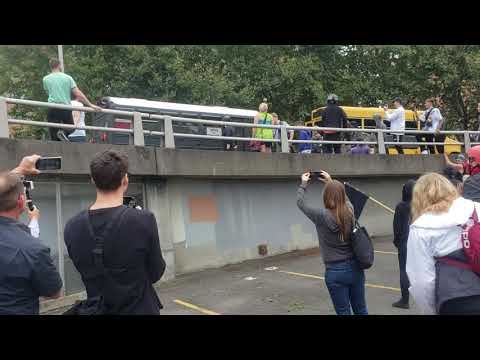
"Antifascist" demonstration Portland, Oregon. August 17, 2019. The two sides squared off across a field, defined by police cord...
-
"Antifascist" demonstration Portland, Oregon. August 17, 2019. The two sides squared off across a field, defined by police cord...
-
Another six hours monitoring livestreams last night. Courtesy of: AustinZone LiveNow Media JacobSnakeUp


